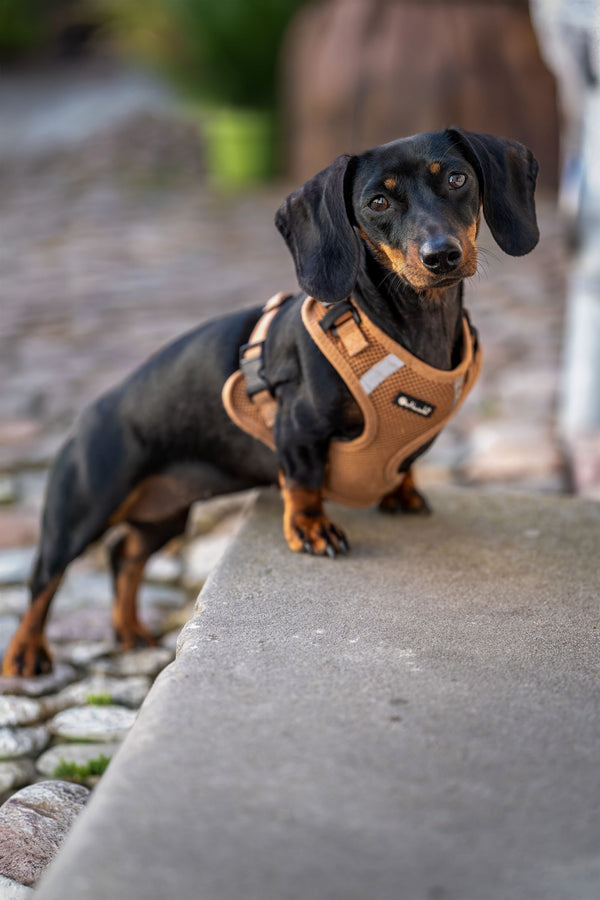
You sit down with a coffee. Your doxie immediately starts looking for their next assignment. Teaching a dachshund to settle on a mat gives you a way to practise quiet time together, first at home and eventually in suitable places outside. Start with comfort and small successes rather than expecting a long café lunch.
- Begin in a quiet room after your dog's basic needs are met.
- Reward relaxed choices without repeatedly asking for attention.
- Build duration and distractions separately.
- Make outings short enough that you can leave comfortably.
Choose a comfortable starting spot
Use a mat or blanket large enough for your dog to lie in a natural position, on a surface that will not slide. Place it away from a busy doorway. Offer a toilet break and water first. A dog who needs something is not failing a training exercise by asking for it.
You can use a familiar resting spot to begin. Our dachshund bed guide covers comfort considerations; no special training mat is required. Keep household activity low while your dog learns what quiet time feels like.
Reward the small signs of relaxing
Dogs Trust's settle training guide recommends starting somewhere quiet, rewarding relaxed behaviour and gradually extending the time before rewards. As your dog becomes comfortable, practise around manageable distractions.
Sit near the mat and give your dog room to choose a position. Quietly place a small reward within easy reach when they pause comfortably there. Look for softer posture or resting rather than expecting a perfect down immediately. Keep your own movements low-key.
At first, a few comfortable moments can be enough. Later, space rewards out a little without turning the exercise into a test of endurance. If every reward makes your dog spring up, try smaller, calmer delivery and an easier session.
Do not push your dog into position or keep repeating “settle”. The mat should predict an easy place to be. If they leave, check whether they need a break or whether the room is too distracting.
A practical progression table
| Stage | Try this | Ready to progress when… |
|---|---|---|
| Quiet room | Sit nearby while your dog rests on or near the mat | They can soften their posture without constant prompting |
| Ordinary home activity | Turn a page or briefly move a cup | Small movements do not repeatedly bring them to their feet |
| Another familiar space | Use the same mat in a quieter second room | They can settle again after exploring |
| Suitable outdoor location | A brief stop with plenty of distance from activity | They remain comfortable and can disengage from passing sights |
These stages have no fixed dates. A change of place may mean returning to much shorter practice. Record the location and the distraction that caused difficulty so the next attempt is easier to plan.
Before trying a dog-friendly café
Check the venue welcomes dogs and choose a quiet time. A first visit can be a short stop rather than a meal. Pick a position where your dog is out of the walkway, away from other dogs and not trapped between chair legs.
- Pack the familiar mat, water, bowl, waste bags and suitable rewards.
- Check harness fit and keep the lead under your control.
- Avoid attaching your dog to lightweight furniture that could move or fall.
- Ask people to give your dog space instead of greeting them while they rest.
- Have a simple exit plan if the environment becomes busy.
Our harness size guide and loose-lead walking guide help with preparation for the journey. Never leave a dog tied up outside a venue while you go inside.
If settling is not happening
A dog who keeps watching the entrance may need a different seat or more distance. A dog who repeatedly gets up may need a toilet break, a cooler spot or a shorter visit. Leaving early is useful information for your next plan.
Dogs Trust notes that sudden restlessness can have a health cause. Speak to your vet if your dog newly struggles to get comfortable. If the difficulty is mainly being away from you, read our separation anxiety guide; mat practice alone is not a treatment for distress.
Common questions
Is settling the same as staying?
No. A stay asks a dog to hold a position. Settling is about becoming comfortable with quiet time; a dog can be still without feeling relaxed.
Should I buy a new mat?
Not necessarily. A familiar, comfortable blanket or mat that stays secure on the floor is enough to start.
What if my dachshund never enjoys cafés?
You can use the skill at home and choose outings your dog enjoys. There is no need to make busy public spaces part of every dog's routine.
General information, not individual veterinary or behaviour advice. Adapt activities to your dog's health and comfort.
Photo: Mylo Kaye on Unsplash, used under the Unsplash License. Stock photograph; not a product demonstration.